 Free eLearning Platform
The Perils of Not Understanding Your Fiduciary Duty

By Rodolfo Giacoman, Fatigue Management Specialist, Commercial Vehicle Safety Alliance
Originally published in the 2025 Fourth Quarter Guardian, pages 47-48
- In an era of nuclear verdicts, escalating insurance premiums and intense regulatory scrutiny, fiduciary duty has become a defining factor in long-term carrier viability.
- This article examines how fatigue management, HOS compliance and safety culture directly influence operating authority, enterprise value and reputational capital.
- Through the framework of the North American Fatigue Management Program (NAFMP), it presents a strategic model for protecting both drivers’ livelihoods and corporate solvency.
- Because in today’s environment, unmanaged fatigue is not just a safety risk — it is a balance sheet risk.
- Are you leading risk — or underwriting it unknowingly?
Estimated Reading time: 9–11 minutes
As a commercial driver…
Fiduciary duty is acting with the highest possible care and integrity for the long-term benefit of those who rely on you, even when it conflicts with your immediate self-interest.
Your fiduciary duty means you have a fundamental legal and ethical obligation to act in the best interests of the people and entities who rely on you. That includes your family, your company and the public on the roads. Their best interest is not limited to today’s trip, this week’s family events or this month’s rent. It is a responsibility you will hopefully have for decades to come.
You and your commercial driver’s license (CDL) are your family’s most valuable financial asset. Your fiduciary duty is to protect these assets above any short-term gain. That means you must value your wellbeing, safety and compliance, even when it costs you an extra trip or a bonus.
Breaches of fiduciary duty happen when short-term gain is prioritized. A driver who speeds, operates an unsafe vehicle or drives fatigued risks their CDL and their family’s sustenance due to a crash. For the motor carrier, reckless driving or dishonest logbooks expose the business to massive liability and risk its operating authority. Ultimately, any action that needlessly endangers the public is a breach of societal trust essential to this profession.
As a motor carrier representative…
Fiduciary duty is a core legal and moral obligation to operate the business in a way that safeguards the long-term wealth and survival of the enterprise and its stakeholders.
Your fiduciary duty means you have a fundamental legal and ethical obligation to act in the best interest of your shareholders or owners, employees and the public. Their best interest is not limited to this week’s current payroll, the quarterly income or this year’s financials. It is a responsibility to ensure the viability and profitability of the enterprise for decades to come.
Your obligation is to protect the company's most valuable, non-physical asset: its operating authority and reputation. Your duty is to provide a safe workplace and the resources necessary for your employees to meet their professional obligations without having to choose between safety and income. And your duty is also to operate with the highest degree of caution and prudence to minimize the inherent dangers of commercial motor vehicles (CMV) on public roads.
Skimping on truck maintenance or encouraging unsafe driver practices might save a few dollars today. However, a single catastrophic crash or a poor safety rating may lead to higher insurance costs, legal judgments and the loss of contracts. These long-term consequences are a clear failure to protect the company's assets and financial future.
When a carrier pressures a driver to violate hours-of-service (HOS) rules, sends them out in a defective CMV or cuts pay for required work-related time, it puts drivers’ livelihoods and physical well-being at risk. If that driver is involved in a serious crash, the carrier becomes legally and ethically liable, thereby constituting a significant breach of its duty of care. Any policy, dispatch instruction or systemic failure that prioritizes profit over road safety is a direct breach of public trust and ultimately risks the company's operating authority.
How to Fulfill Your Fiduciary Duty
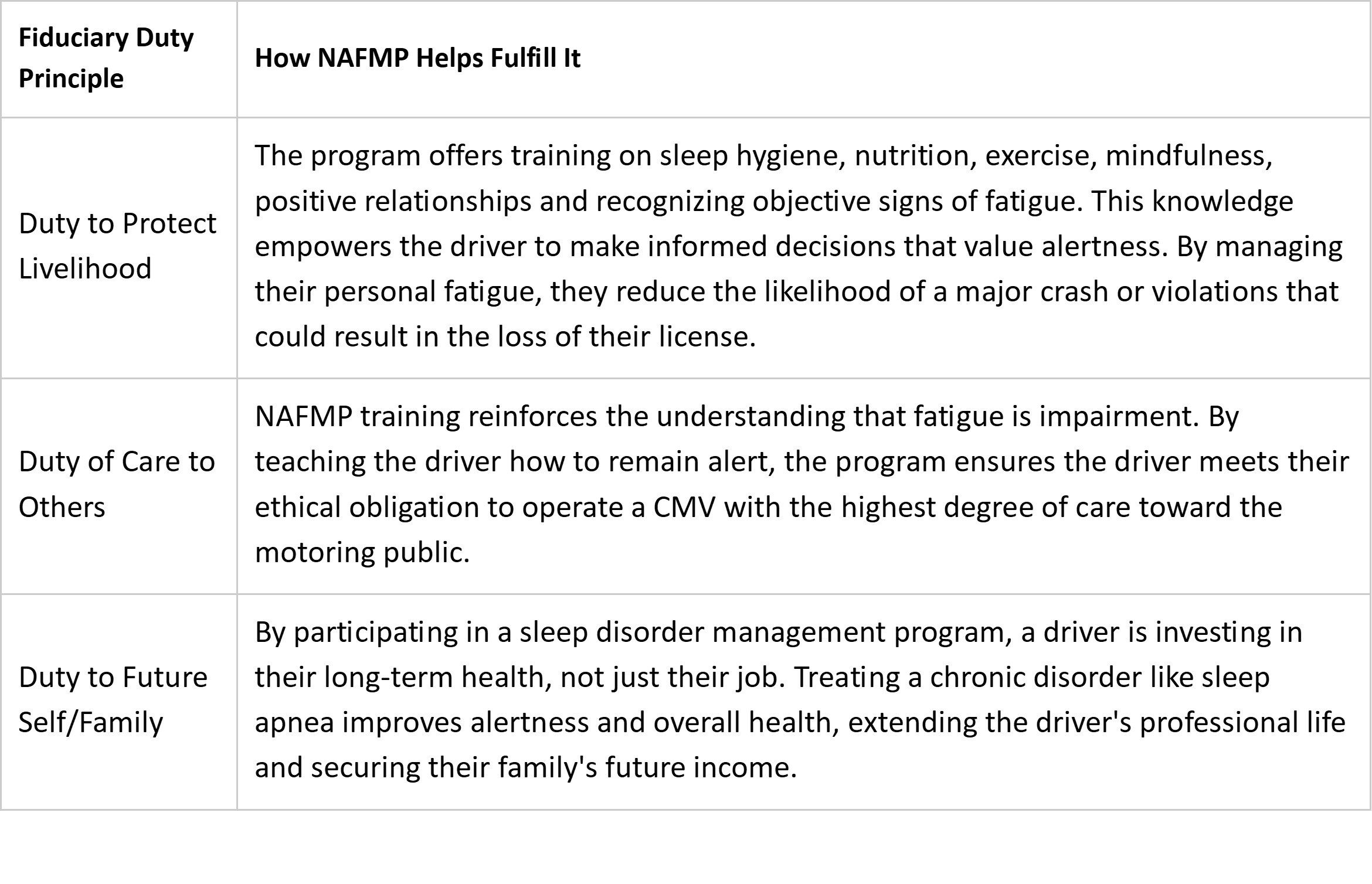
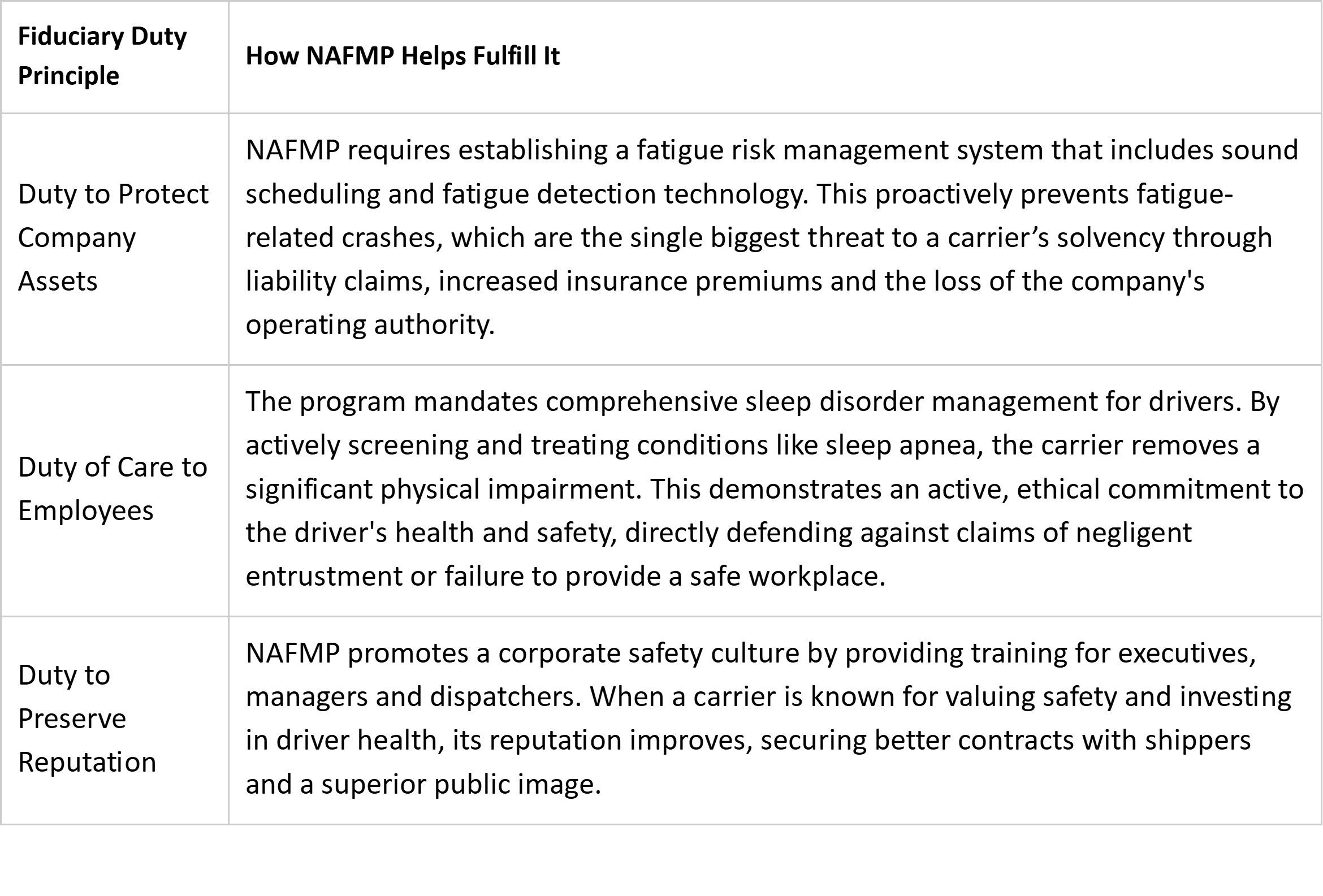
Implementing a fatigue management program in accordance with the recommendations of the North American Fatigue Management Program (NAFMP) is one of the most direct and effective ways for both professional drivers and motor carriers to fulfill their fiduciary duties.
The NAFMP shifts the focus from merely complying with HOS rules to proactively managing the risk of fatigue, directly protecting the critical assets of all parties.
As a commercial driver…
As a motor carrier…
Considering Your Safety Department as Crucial to Long-Term Profits
While some motor carriers may view their safety department as an unprofitable cost center, this is a shortsighted perspective. A strong safety program is a crucial, high-value investment that delivers a significant return by reducing major expenses and increasing revenue. An ineffective or underfunded safety department, by contrast, can destroy a motor carrier's profitability.
A well-run safety department improves a motor carrier's bottom line in multiple ways:
- Insurers base rates on a carrier's risk, which is determined by factors like crash history and Safety Measurement System (SMS) scores. A strong safety record demonstrates a lower risk, leading to more favorable insurance rates.
- An effective safety department ensures compliance with Federal Motor Carrier Safety Regulations (FMCSRs). This helps carriers avoid costly fines and penalties. A documented safety program also provides a strong legal defense against negligence lawsuits, protecting the company from nuclear verdicts.
- Proactive safety measures, such as driver training, monitoring and regular vehicle maintenance, directly lead to fewer crashes. This reduces costs associated with vehicle repairs, cargo loss and legal fees.
- A company with a strong safety culture is more likely to attract and keep qualified drivers. This helps the carrier avoid high driver turnover costs, including expenses for recruiting, hiring and training new drivers.
- Safety protocols can improve fuel efficiency by promoting safer driving habits, like avoiding harsh braking and rapid acceleration. Preventive maintenance also extends vehicle lifespan and minimizes costly, unexpected repairs.
The choice is simple: Will you manage risk proactively or wait to be managed by consequence? Fulfilling your fiduciary duty – whether to your family, your shareholders or the public – requires more than good intentions; it demands action. Failure to act is not a passive choice; it is itself a breach.
NAFMP provides the tangible, evidence-based roadmap you need. Don't risk a lifetime of professional investment and financial stability by treating fatigue management as an optional expense. View it for what it is: the essential insurance policy for your career and your company's future.
For CMV and motor carriers ready to make this crucial, profitable investment, all training modules, implementation guides and program resources are available to you for free at nafmp.org. By engaging with these resources, you move beyond merely understanding the perils and take the decisive action required to prevent them.
Keep your questions and comments coming at rodolfo.giacoman@cvsa.org.
More Reading
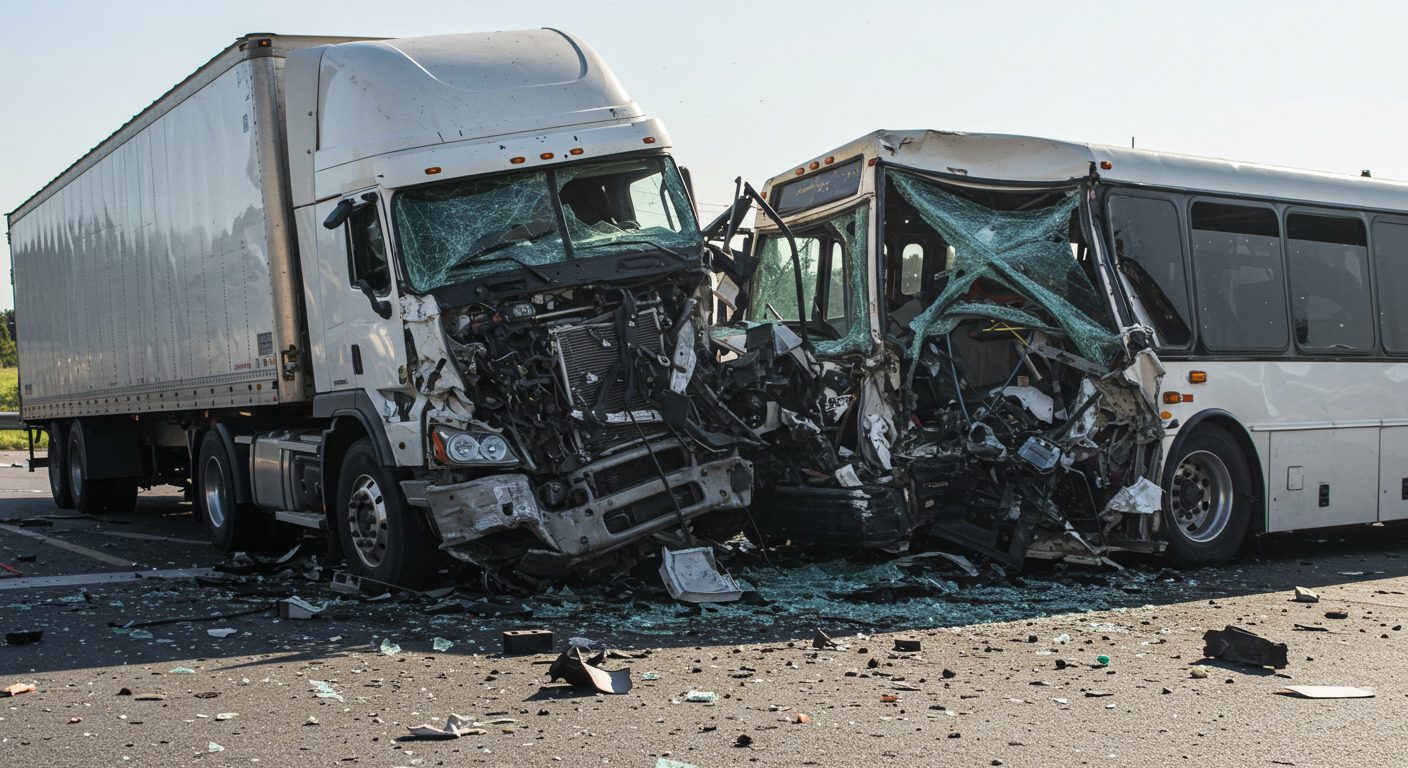
What Do These Six Crashes Have in Common?