
 Free eLearning Platform
DISTRACTED DRIVING in the CMV INDUSTRY, New Challenges, New Tools
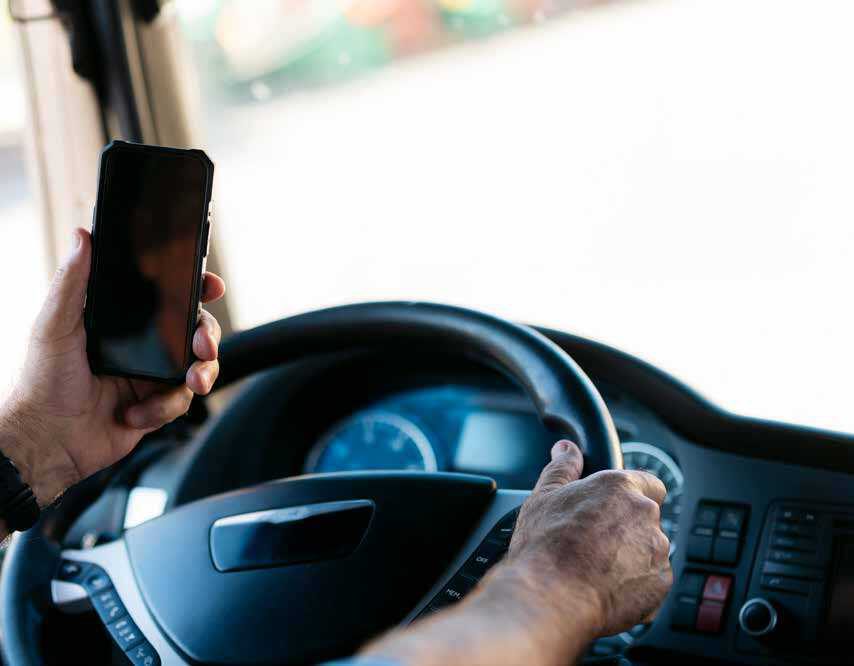
Originally published in the 2026 Second Quarter Guardian, Pages 31- 37
- Distracted driving is killing drivers—and CMV operations are uniquely exposed.
- Staggering data and case studies show phones, fatigue and in‑cab tasks multiply crash risk for professional drivers.
- Learn which enforcement campaigns, fleet policies and emerging AI/telematics actually reduce incidents.
- Actionable strategies for carriers: tech, training and culture changes that cut liability, downtime and insurance costs.
- Read on for evidence, enforcement results and practical implementation steps.
Estimated read time: 10 minutes.
In 2018, in Minneapolis, Minnesota, a 28-year-old semitruck driver was using his cellphone to research houses for sale – while driving. He looked at his phone for eight seconds while going 63 miles per hour, traveling a distance of about 740 feet, as far as the Golden Gate Bridge is tall. While distracted by his research, he slammed into a passenger vehicle and killed the occupant, who was a husband, father and local professor. The driver was sentenced to one year in jail, 10 years of probation and a suspended commercial driver’s license (CDL).
Distracted driving isn’t always this extreme. And part of what makes it so dangerous is that it is so commonplace. Commercial motor vehicle (CMV) and passenger vehicle drivers alike are often distracted by things like changing music, helping little passengers in the back seat, unwrapping a fast-food burger, rubbernecking at a crash or sending a “quick text.” And often, nothing bad happens. Maybe you get too close to the person in front of you and have to apply your brakes a little more forcefully than normal. Maybe you get a spike of adrenaline, put down your phone and vow to pay more attention next time. But just because it happens frequently and to nearly everyone who has driven a vehicle doesn’t mean that distracted driving is something society must accept instead of solve.
What Is Distracted Driving?
While there are various definitions of distracted driving from different safety-focused agencies, it is commonly defined as a driver’s attention being diverted from driving by a secondary task that requires focusing on an object, event or person not related to the driving task. The U.S. National Highway Traffic Safety Administration (NHTSA) and Transport Canada provide examples of distracting activities, such as talking or texting on your phone; eating or drinking; talking to people in your vehicle; or fiddling with the stereo, entertainment or navigation system.
Let’s take a look at recent studies on distracted driving across all vehicle types and CMVs specifically.
- According to NHTSA, distracted driving (all vehicle types) claimed 3,275 lives in 2023, and an additional 289,310 people were injured.
- In 2022, distracted driving (all vehicle types) was a contributing factor in 19.9% of fatal collisions in Canada.
- Drivers who use their phone behind the wheel (all vehicle types) are 240% more likely to crash, according to a 2025 study by the Governors Highway Safety Association.
- 22.4% of drivers in Mexico (all vehicle types) admitted to using a handheld cellphone while driving, even though 96.8% of those surveyed identified this as a high risk behavior, according to a study titled “It’s okay because I’m just driving”: an exploration of self-reported mobile phone use among Mexican drivers.
- A 2009 Federal Motor Carrier Safety Administration (FMCSA) study found that 71% of large-truck crashes occurred when the truck driver was doing something other than driving.
- A 2021 study by Omnitracks found that truck drivers who are distracted by mobile phones are three times more likely to exceed the speed limit by 10+ miles per hour.
- An FMCSA and Virginia Tech Transportation Institute (VTTI) study showed that, compared to personal motorists, CMV drivers are 23 times more likely to cause a crash while texting at the wheel, seven times more likely when reaching for an electronic device and six times more likely when dialing a phone.
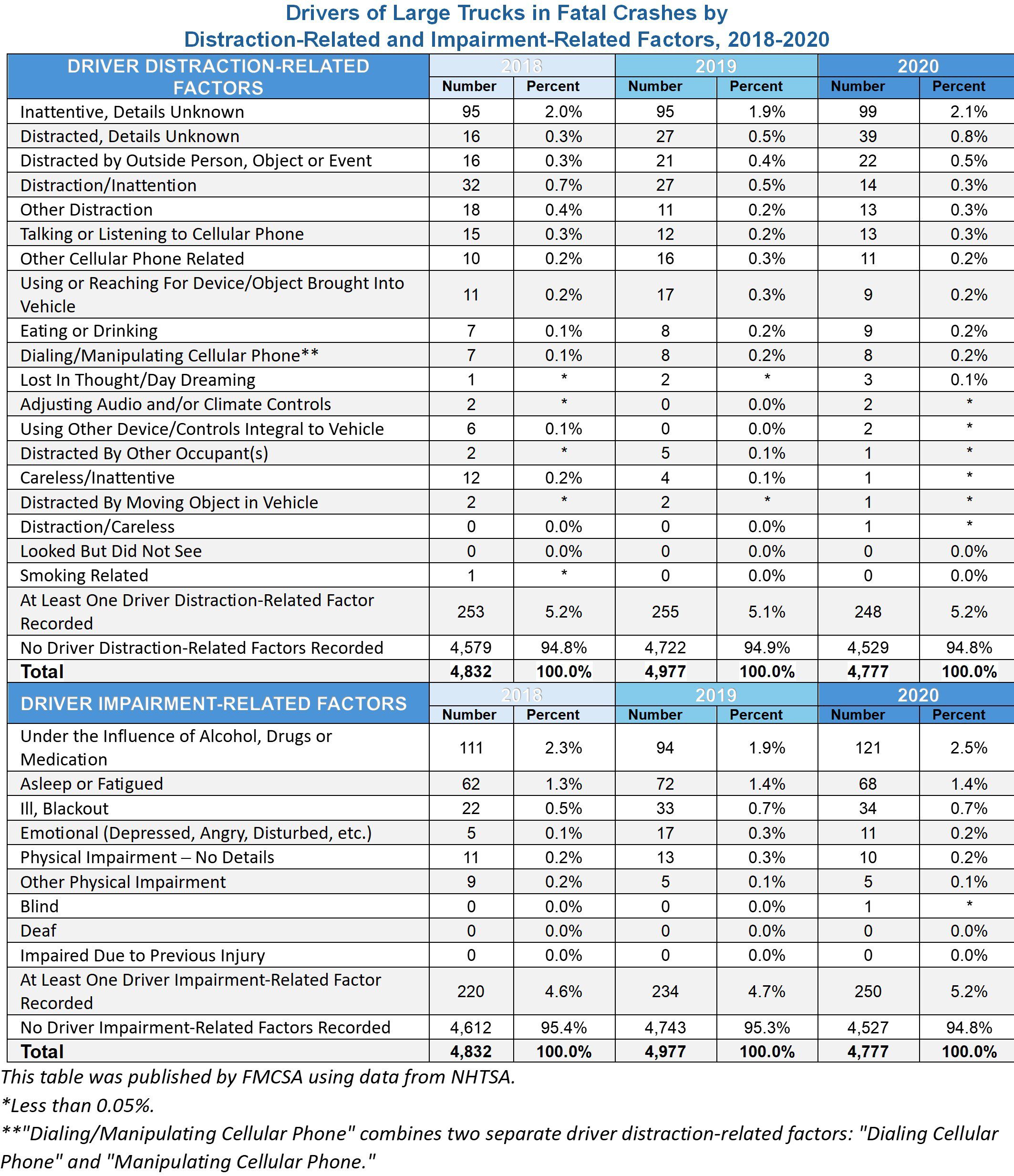
- According to the FMCSA Large Truck and Bus Crash Facts report, in 2021, distraction or inattention was the second most common large truck driver-related crash factor, accounting for 278 fatal crashes.
Distracted driving can be deadly, and it’s clear that this problem runs deep in our society. There is some good news, though. Between government agencies, nonprofit organizations like CVSA, researchers and the motor carrier industry, many parties are committed to getting to the bottom of the problem of distracted CMV driving and promoting safety, preventing crashes and saving lives. Agencies are embracing creative enforcement campaigns and partnerships to curb device use behind the wheel, while carriers are turning to telematics and in-cab monitoring to address the problem from within and as part of ongoing training.
Types and Sources of Distractions
Distractions are everywhere, and they can come from inside or outside the cab. Distractions outside the cab can include looking at a passing building, billboard or person. A three-year data-collection effort by FMCSA and NHTSA found that an estimated 11,000 U.S. large-truck crashes involved distractions external to the truck cab.
Distractions inside the cab can include dialing cellphones, texting, using dispatching devices, eating, reaching for items in the cab, reading or adjusting the radio. When you get down to it, anything that takes the driver away from the driving task is a distraction.
TYPES OF DISTRACTION:
Visual Distraction – Not looking at the road or other vehicles while driving
Cognitive Distraction – Mental attention not focused on driving
Manual Distraction – Removing hands from the steering wheel to reach for a
cellphone, food/drink, etc.
Delayed Reaction – Not being able to stop in time to avoid a collision due to distractions
A 2006 study found that driver inattention was the leading factor in crashes and near-crashes. The study found that nearly 80% of crashes involved some form of driver inattention in the three seconds before the crash or near-crash.
Texting while driving is one of the most dangerous forms of distracted driving because it combines visual, manual and cognitive distractions all at once. A 2006 University of Utah study shows that the impairments associated with using a cellphone while driving can be as profound as those associated with driving while impaired.
Enforcement Tactics and Outreach
CVSA addresses unsafe CMV driver behaviors through its Operation Safe Driver program by educating all drivers on how to share the road safely. This program focuses specifically on drivers because drivers’ actions – whether it’s something a driver does, like speeding, or something they don’t do, such as not paying attention to the driving task – are responsible for most crashes. In fact, drivers’ actions account for a staggering 94% of all traffic crashes. However, research from the University of Missouri-Columbia has shown that interactions with law enforcement do alter drivers’ actions.
The focus of CVSA’s 2025 Operation Safe Driver Week was reckless/careless/inattentive driving. Any person who drives a vehicle in willful or wanton disregard for the safety of persons or property is driving recklessly. Careless/ dangerous driving is defined as operating a vehicle without due care and attention or reasonable consideration for other motorists or people on the road. From July 13-19, 2025, officers/inspectors in the U.S. and Canada gave 12 citations and 47 warnings to CMV drivers for reckless/careless/inattentive driving. And CMV drivers received 107 warnings and 79 tickets/ citations for texting/using a handheld device while operating a CMV. View the full results of the campaign: https://cvsa.org/news/2025-osd-week-results/.
In addition to traffic stops, another important aspect of the Operation Safe Driver Week initiative is raising public awareness of the dangers of unsafe driving behaviors. In the months leading up to Operation Safe Driver Week, CVSA mailed nearly 70,000 postcards to inspectors and motor carriers for distribution and worked with the Paramount/CBS network to distribute public service announcements focused on safe driving, delivering more than 15 million campaign impressions.
Notable enforcement outreach included:
- The Colorado State Patrol conducted distracted driving awareness discussions and included distracted driving handouts with applicable inspections.
- The Florida Highway Patrol conducted educational outreach at a FedEx distribution center, reaching 30 professional drivers. The discussion topics included driver safety, distracted driving, cellphone usage, safety belt compliance, pre-trip inspections, speeding and a demonstration of a Level II Inspection.
- The Hawaii Department of Transportation conducted safe driver outreach, including distributing safety brochures; discussing the dangers of speeding, distracted driving and aggressive driving; and handing out lanyards and mini first-aid kits.
In addition to targeted enforcement and outreach initiatives, local/state/provincial/ territorial agencies make distracted driving education a priority throughout the year. Officers and inspectors conduct outreach focused on distracted driving and cellphone use during individual inspections and educational/community events with motor carriers, high schools, driving schools and other organizations. Their efforts ensure distracted driving awareness and prevention are priorities discussed and addressed year-round.
Emerging Technologies
Motor carriers are embracing emerging technology to gather data, recognize patterns, provide driver alerts and interrupt distraction before crashes occur. This includes AI-powered, driver-facing cameras that detect phone use or fatigue. These systems, combined with telematics and advanced driver-assistance systems, provide real-time alerts and data for driver coaching.
- AI-Powered Dash Cameras: AI dashcams are advanced vehicle cameras that use artificial intelligence to analyze road conditions and driver behavior in real time, enhancing safety through proactive alerts. They typically feature dual-facing cameras (road and cabin) to detect risks, such as drowsiness, tailgating and cellphone use, often connecting to cloud services for fleet management and video evidence. They can also detect when a driver's eyes are off the road, when they are looking at a phone or when they exhibit signs of fatigue. They can trigger immediate, in-cab audio alerts and record events for coaching.
- Telematics and Driver Monitoring: Telematics and driver monitoring systems combine GPS, onboard diagnostics and sensors to track vehicle location and driving behavior in real time. These systems, which may integrate with AI-powered dashcams, enhance safety by identifying risks like speeding, erratic steering, tailgating, and harsh acceleration and braking, which often correlate with distractions.
- Coaching and Behavior Analytics: Data from cameras and sensors allow managers to identify high-risk drivers, offering targeted training to improve safety habits. In addition, these systems can provide real-time, audible alerts to the driver, often using voice coaching to correct behavior immediately rather than just recording it.
- Forward Collision Mitigation: These systems use cameras and sensors to monitor the road and issue warnings when a driver is following too closely, a risk often caused by inattention.
- Predictive Fatigue Monitoring: Beyond detecting closed eyes, new technology uses wearable sensors and smartphone-based tests to measure driver alertness. Some systems analyze hours-of-service logs to create a "fatigue score" that updates every 15 minutes, allowing managers to intervene before safety is compromised.
- Mobile Device-Blocking Technology: While “do not disturb” and “driving mode” functions have existed for quite some time and can be toggled on and off by the user, mobile device-blocking technology does not require user cooperation. These solutions actively prevent the use of apps, texting and calling while the vehicle is in motion, while often allowing for emergency calls. The mandatory use of this technology has been highly controversial due to debates over safety, privacy, personal freedom and effectiveness.
Carrier-Led Prevention
Technology alone cannot ensure safe, distraction-free driving. Technology is best combined with a culture of safety – going beyond compliance – to tackle distracted driving from many angles.
Motor carriers are combining AI and telematics technology with clear policies, training, behavior-based safety programs and safe-driving incentives to create a safety culture and tackle distracted driving.
- Clear Policies: A successful distracted driving policy starts with transparent expectations for driver behavior and clear consequences for violations. Policies may include:
- Zero Tolerance Policy: Drivers are prohibited from using handheld phones or devices for texting or calling while the vehicle is in motion, in compliance with regulations.
- In-Cab Technology Limits: GPS devices and other technology should be voiceactivated or programmed before driving to minimize distractions.
- Fatigue Management Programs: Fatigue is often a cause of cognitive distraction. Encourage breaks, enforce compliance with hour-of-service rules and implement policies that promote rest.
- Penalties for Violations: Specify that violations of the distracted driving policy will result in disciplinary actions, ranging from warnings to termination, depending on the severity of the violation.
- Training and Behavior-Based Safety Programs: Distracted driving information is a part of entry-level CDL courses, but onetime training is not enough to maintain safe driving practices. Effective, safety-focused motor carriers require ongoing training. This training can include:
- Annual Training Sessions: Review policies, share new statistics and reinforce hands free technologies.
- Scenario-Based Training: Share real world examples, like in-cab videos and simulations, that demonstrate the dangers of distracted driving.
- Driver Coaching: Incorporate telematics data for individualized feedback; schedule one-on-one coaching sessions to address issues.
- Safe Driving Incentives: Reward drivers who adhere to policies, complete training and hit safety goals with safety bonuses or recognition programs.
In addition to improving safety, a comprehensive anti-distraction program benefits a motor carrier’s bottom line, too. For regulated motor carriers, the consequences of distracted driving are severe. Crashes and violations can lead to:
- Increased Insurance Premiums and Legal Liability: Insurance companies often raise premiums for companies with high crash rates and/or poor safety metrics. Lawsuits stemming from crashes caused by distracted driving can cost millions in settlements or judgments.
- Regulatory Fines: Violating FMCSA rules on mobile device use can lead to fines of up to $2,750 for drivers and up to $11,000 for employers, in addition to driver disqualification.
- Operational Disruption and Reputational Damage: Crashes and roadside violations can lead to vehicle downtime, delays in deliveries and damage to client relationships.
Governmental Agency Programs
Government agencies across North America are addressing distracted driving among passenger vehicle and CMV drivers via regulations and educational and enforcement programs.
CANADA
Transport Canada offers a free and comprehensive distraction mitigation program for Canadian motor carriers. Based on a scientific approach to distraction mitigation and driver training, the program aims to curb CMV crashes caused by distraction. The Driver Distraction Mitigation Program (DDMP) includes driver training modules and implementation guidelines that address driver distraction. Transport Canada worked with a team of experts from VTTI to develop the DDMP. Three driver distraction training modules are available in English and French, either with recorded voice-over for self-administration or written narration notes for fleets that want to use an instructor.
The DDMP is available at tc.canada.ca/en/ road-transportation/stay-safe-when-driving/ distracted-driving
MEXICO
Mexico’s federal approach to distracted driving is anchored by the General Law of Mobility and Road Safety, enacted in May 2022 to establish a national framework for mobility and roadway safety. Article 49 requires federal, state and municipal authorities to incorporate minimum traffic safety measures into their regulations, including a prohibition on using cellular phones and other electronic communication devices while driving unless operated through hands-free technology. The law further states that when electronic devices are necessary for the provision of transportation services, such devices must be mounted in a holder that facilitates their operation without obstructing the driver’s visibility.
On federal highways and bridges, traffic enforcement is governed by the Traffic Regulations on Highways and Bridges of Federal Jurisdiction, administered through the Secretariat of Infrastructure, Communications and Transportation and enforced by the National Guard. These rules operate alongside broader federal commercial transportation regulations and Official Mexican Standards governing areas such as vehicle safety, driver qualifications and fatigue-related controls for commercial transportation operations.
The National Guard is responsible for enforcing traffic regulations on federal highways, including the authority to stop drivers and issue citations for traffic violations. Together, the General Law of Mobility and Road Safety, the Traffic Regulations on Highways and Bridges of Federal Jurisdiction, and federal highway enforcement activities form the core of Mexico’s federal strategy to reduce distracted driving and improve roadway safety.
UNITED STATES
Several U.S. agencies are at the forefront of addressing distracted driving. NHTSA not only addresses distracted driving in passenger vehicles but also conducts research to better understand the prevalence of this issue and how to address it. This year, during a portion of Distracted Driving Awareness Month, from April 10-14, agencies across the U.S. increased their roadway presence as part of the national paid media campaign “Put the Phone Away or Pay.” This campaign reminds drivers of the deadly dangers and legal consequences – including fines – of using a hand-held mobile device while driving.
As the primary agency for preventing CMV related crashes, injuries and fatalities, FMCSA has strong policies and programs in place for addressing distracted driving. Title 49 Code of Federal Regulations prohibits texting and driving in § 392.80 – Prohibition against texting and § 392.82 – Using a handheld mobile telephone. An FMCSA final rule imposes sanctions for driver offenses, including civil penalties up to $2,750 and driver disqualification for multiple offenses. Motor carriers are also prohibited from requiring or allowing their drivers to text or use a hand-held mobile phone while driving and may be subject to civil penalties up to $11,000. In addition, violations will impact Safety Measurement System (SMS) results. Texting and calling on a hand-held phone carry the maximum violation severity weighting in SMS.
FMCSA addresses driver distraction in its “Our Roads, Our Safety” campaign and the FMCSA Driver Safety Program. “Our Roads, Our Safety” is a national campaign designed to educate all road users – drivers, cyclists and pedestrians – on how to safely share the road with large trucks and buses. The distracted driving portion of this campaign features resources for motor carriers, drivers and the public, and the full distracted driving toolkit can be accessed at https://www.fmcsa.dot.gov/ourroads/distracted-driving-awareness-resources.
The FMCSA Driver Safety Program is one result of a study conducted in coordination with VTTI. It aims to address “driver error,” which is a primary contributing factor in up to 87% of large-truck crashes. The University of California San Diego Transportation Research and Education for Driving Safety also has a distracted driving course. These programs address driver distraction, failure to buckle up, driving too fast for conditions, unfamiliar roadways, inadequate surveillance, driver fatigue, driving too closely, inadequate evasive action and more.
See the sidebars of this article for distracted driving tips from the FMCSA Driver Safety Program, and read more at https://www.fmcsa.dot.gov/safety/driver-safety/cmv-driving-tips-driver-distractionand https://www.fmcsa.dot.gov/driver-safety/distracted-driving.
Looking Ahead
Distracted driving is a complex problem that is deeply ingrained in our society. And when CMV drivers are distracted, the results can be catastrophic and deadly. The severity of this issue is not going unnoticed, however. Tech developers, the motor carrier industry, researchers, government agencies and organizations like CVSA all play a part in solving this pervasive problem. From the technologies used in truck cabs to impactful statistics and public service announcements to enforcement campaigns and outreach, many different parties are putting in the work to educate the public and end distracted driving.
Next time you’re at the wheel and you’re tempted to pick up your phone, reach into the back seat or eat a snack, remember that anything that distracts from the driving task is distracted driving, and it only takes seconds for tragedy to occur.
Anti-Distraction Tips for Drivers
From the FMCSA Driver Safety Program
- Do not let objects outside the cab distract you. Stay focused on driving and avoid distractions, like billboards, buildings and people.
- Don’t text and drive. If you are driving at 55 mph and take your eyes off the road for five seconds to write a text, you will travel the length of a football field without looking at the road. A 2009 study found that texting while driving increased a driver’s risk of being involved in a safety-critical event by 23 times.
- Don’t use a dispatching device while driving. Although these devices can be helpful in many ways, dispatching devices can take your eyes, hands and mind away from driving safely. A 2009 study found that using a dispatching device while driving increased the chances of a safety-critical event by nine times.
- Don’t dial a handheld phone while driving. Dialing a handheld cellphone takes your eyes off the road and your hands off the wheel. Instead, find a safe place to stop and dial, or use a voice-activated hands-free phone or app. A 2011 study found that drivers who were dialing a handheld cellphone made more frequent and larger steering corrections than drivers talking on a hands-free device.
- Don’t read, write or use paper maps while driving. Printed directions, notes and maps are a normal part of a professional driver’s job, but these tasks take your eyes off the road. If you need to read or write something, pull over. Voice-activated GPS units are much safer to use while driving than maps.
- Avoid eating and drinking while driving. Eating while driving can take your eyes off the road and requires at least one hand off the wheel. Always try to eat or drink before getting behind the wheel or leave time to pull over and eat. In May 2008 in Wisconsin, a CMV driver crashed into the back of a stopped school bus, which had its lights flashing and stop arm out. The CMV driver, distracted by drinking a soda, did not see the school bus. Fourteen children were taken to the hospital, four with serious injuries. The CMV driver was transported to the hospital in critical condition.
To get involved with the Operation Safe Driver Program and receive communications, log into the CVSA member portal at portal.cvsa.org, navigate to your profile and select “Operation Safe Driver Program.”

NTSB Distracted Driving Case Studies
July 19, 2013 | Annapolis, Maryland
At 8:24 p.m., a passenger car was traveling eastbound on US Route 50/301. The car passed through the toll plaza to enter the eastbound span of the Chesapeake Bay Bridge, where traffic was slowed. The car reduced its speed to 4 mph when it was struck from behind by a truck-tractor and refrigerated semitrailer combination unit traveling 47 mph. The truck-tractor collided with the car, pushing the car into the concrete barrier.
As the vehicles continued forward, the front of the car collided with another car occupied by a driver and his wife. The original car was pushed up onto the barrier wall and then rode along its top before falling approximately 27 feet into the Chesapeake Bay, where it came to rest between two bridge piers in seven feet of water. The driver swam to a nearby bridge pier, from which she was rescued, transported to an area hospital and treated for minor injuries. The second car came to rest near the truck-tractor in the middle of the two travel lanes. The truck driver and both of the second car’s occupants were uninjured.
NTSB determined that the probable cause for the crash was the failure of the trucktractor driver to slow for traffic due to his inattention to the forward roadway while looking in his side view mirror.
Aug. 5, 2010 | Gray Summit, Missouri

Traffic was slowed in the approach to an active work zone on eastbound Interstate 44. A truck-tractor had slowed or stopped behind traffic. At 10:11 a.m., a light-duty pickup truck merged and struck the rear of the tractor. This collision was the first of three. Two school buses were approaching the slowed traffic and collision ahead. The lead bus was a 71-passenger bus carrying 23 passengers, and the following bus was a 72-passenger bus carrying 31 passengers.
Seconds after the lead bus passed a motorcoach that had stopped on the shoulder, it struck the rear of the pickup truck. This second collision caused the pickup truck to overturn onto the back of the truck-tractor. The front of the lead bus came to rest on top of the pickup truck and truck-tractor. Moments later, the following bus struck the lead bus. The driver of the pickup truck and one passenger seated in the rear of the lead bus were killed. A total of 35 bus passengers, the two bus drivers and the driver of the truck-tractor were injured. Eighteen people were uninjured.
NTSB determined that the probable cause of the initial collision was distraction, likely due to a text conversation by the pickup truck driver. The second collision was the result of the bus driver’s inattention due to excessive focus on a motorcoach parked on the shoulder of the road. The final collision occurred because the driver of the following school bus failed to maintain the recommended minimum distance from the lead school bus. The severity of the crash was exacerbated by the lack of forward-collision warning systems on the two school buses.
March 26, 2010 | Munfordville, Kentucky
A truck-tractor semitrailer was traveling south on I-65 when it departed the left lane and entered the 60-foot-wide depressed earthen median between the southbound and northbound roadways. The truck traveled across the median and struck and overrode the high-tension median cable barrier adjacent to the left shoulder of northbound I-65. It then crossed the shoulder and entered the lanes of northbound I-65.
A 15-passenger van with 12 occupants was traveling northbound in the left lane. As the truck crossed in front of the van, its tractor was struck by the van. As a result of the crash and the truck fire that ensued, the truck driver, the van driver and nine van passengers died. Two child passengers in the van, who were using child restraints, sustained minor injuries.
Driver distraction/cellphone use was determined to be one of the causes of the crash. By mapping cellular tower service for the truck driver’s phone, investigators determined that the driver used his phone to make and receive calls as well as send and receive text messages a total of 69 times while driving in the 24 hours prior to the crash.
More Reading