 Plateforme d'eLearning
CONDUITE DISTRAITE dans L'INDUSTRIE VDA - Nouveaux Enjeux, Nouveaux Outils
Publié à l'origine dans le Guardian, deuxième trimestre 2026, pages 31–37
- La conduite distraite tue des conducteurs — et les exploitations VDA y sont particulièrement exposées.
- Des données et études de cas stupéfiantes montrent que les téléphones, la fatigue et les tâches en cabine multiplient le risque d'accident pour les conducteurs professionnels.
- Découvrez quelles campagnes d'application, quelles politiques de flotte et quelles technologies émergentes (IA/télématique) réduisent effectivement les incidents.
- Stratégies opérationnelles pour les transporteurs : changements technologiques, formation et culture qui réduisent la responsabilité, les temps d'immobilisation et les coûts d'assurance.
Lisez la suite pour des preuves, des résultats d'application et des étapes pratiques de mise en œuvre.
Temps de lecture estimé : 10 minutes
En 2018, à Minneapolis (Minnesota), un conducteur de semi-remorque de 28 ans utilisait son téléphone portable pour consulter des maisons à vendre — tout en conduisant. Il a regardé son téléphone pendant huit secondes alors qu'il roulait à 63 miles par heure, parcourant une distance d'environ 740 pieds, soit à peu près la hauteur du Golden Gate Bridge. Distrait par ses recherches, il a percuté un véhicule de tourisme et a tué l'occupant, qui était mari, père et professeur local. Le conducteur a été condamné à un an de prison, dix ans de probation et à la suspension de son permis de conduire commercial (CDL).
La conduite distraite n'est pas toujours aussi extrême. Et ce qui la rend particulièrement dangereuse, c'est son caractère banal. Les conducteurs de véhicules routiers commerciaux (VDA) comme les conducteurs de véhicules particuliers sont souvent distraits par des activités telles que changer la musique, aider de petits passagers à l'arrière, déballer un hamburger, regarder avec curiosité un accident ou envoyer un « texto rapide ». Et souvent, rien de grave ne se produit. Peut-être se rapprochent-ils un peu trop du véhicule devant et doivent freiner un peu plus fort que d'habitude. Peut-être ont-ils un pic d'adrénaline, reposent leur téléphone et promettent d'être plus attentifs la prochaine fois. Mais le fait que cela arrive fréquemment et à presque tous ceux qui ont déjà pris le volant ne signifie pas que la conduite distraite est une fatalité que la société doit accepter plutôt que résoudre.
Qu'est-ce que la conduite distraite?
Bien qu'il existe plusieurs définitions émanant de différentes agences axées sur la sécurité, on définit couramment la conduite distraite comme le fait que l'attention du conducteur soit détournée de la conduite par une tâche secondaire qui exige de focaliser sur un objet, un événement ou une personne non liés à la tâche de conduite. La National Highway Traffic Safety Administration (NHTSA) des États-Unis et Transports Canada donnent des exemples d'activités distrayantes, telles que parler ou envoyer des textos sur son téléphone; manger ou boire; parler à des personnes dans le véhicule; ou manipuler la stéréo, le système de divertissement ou de navigation.
Examinons les études récentes sur la conduite distraite, tous types de véhicules confondus et spécifiquement pour les VDA.
- Selon la NHTSA, la conduite distraite (tous types de véhicules) a causé 3 275 décès en 2023, et 289 310 personnes supplémentaires ont été blessées.
- En 2022, la conduite distraite (tous types de véhicules) a été un facteur contributif dans 19,9 % des collisions mortelles au Canada.
- Les conducteurs qui utilisent leur téléphone au volant (tous types de véhicules) ont 240 % plus de risques d'avoir un accident, selon une étude 2025 de la Governors Highway Safety Association.
- 22,4 % des conducteurs au Mexique (tous types de véhicules) ont admis utiliser un téléphone portable tenu en main en conduisant, bien que 96,8 % des personnes interrogées aient identifié ce comportement comme hautement risqué, selon l'étude intitulée « It's okay because I'm just driving » : an exploration of self-reported mobile phone use among Mexican drivers.
- Une étude de 2009 de la Federal Motor Carrier Safety Administration (FMCSA) a révélé que 71 % des accidents impliquant des grands camions sont survenus alors que le conducteur du camion faisait quelque chose d'autre que conduire.
- Une étude de 2021 d'Omnitracks a montré que les conducteurs de camion distraits par leur téléphone mobile ont trois fois plus de chances de dépasser la limite de vitesse de 10+ miles par heure.
- Une étude conjointe FMCSA et Virginia Tech Transportation Institute (VTTI) a montré que, comparativement aux automobilistes particuliers, les conducteurs VDA sont 23 fois plus susceptibles de provoquer un accident en envoyant des textos au volant, sept fois plus susceptibles lorsqu'ils atteignent un appareil électronique et six fois plus susceptibles lorsqu'ils composent un numéro sur un téléphone.
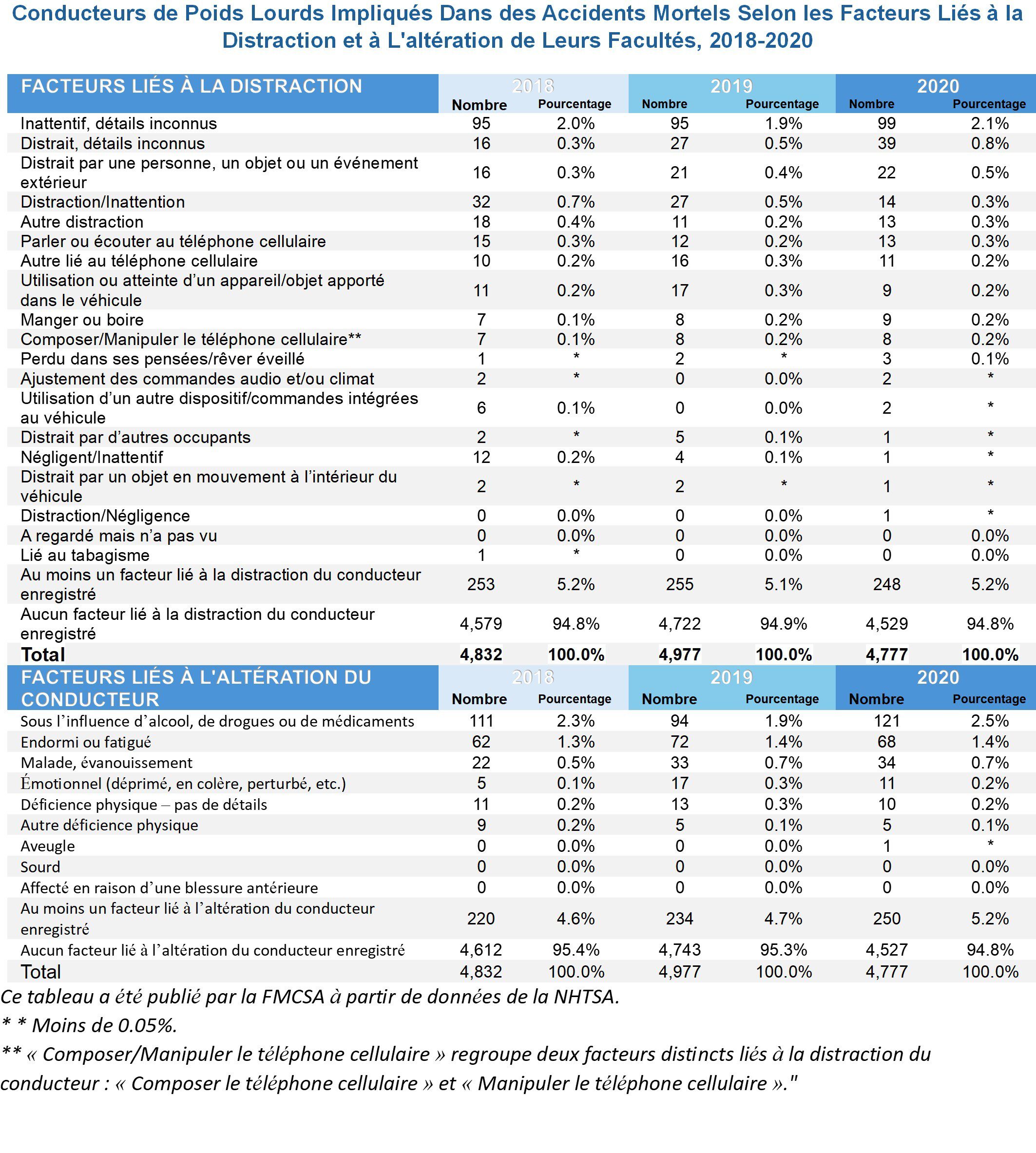
- Selon le rapport FMCSA Large Truck and Bus Crash Facts, en 2021, la distraction ou l'inattention était le deuxième facteur le plus courant lié aux conducteurs de grands camions, représentant 278 collisions mortelles.
La conduite distraite peut être mortelle, et il est clair que ce problème est profondément ancré dans notre société. Il y a néanmoins des bonnes Nouvelles. Parmi les agences gouvernementales, les organisations à but non lucratif comme la CVSA, les chercheurs et l'industrie du transport routier, beaucoup d'acteurs s'engagent à traiter le problème de la conduite distraite des VDA pour promouvoir la sécurité, prévenir les accidents et sauver des vies. Les agences adoptent des campagnes d'application et des partenariats créatifs pour réduire l'utilisation d'appareils au volant, tandis que les transporteurs tournent vers la télématique et la surveillance en cabine pour s'attaquer au problème de l'intérieur et dans le cadre de la formation continue.
Types et Sources de Distractions
Les distractions sont omniprésentes et peuvent provenir de l'intérieur ou de l'extérieur de la cabine. Les distractions extérieures incluent regarder un bâtiment passant, un panneau publicitaire ou une personne. Un effort de collecte de données sur trois ans mené par la FMCSA et la NHTSA a estimé qu'environ 11 000 collisions impliquant de grands camions aux États-Unis concernaient des distractions externes à la cabine du camion. Les distractions à l'intérieur de la cabine peuvent inclure la composition sur un téléphone portable, l'envoi de textos, l'utilisation d'appareils de répartition, manger, atteindre des objets dans la cabine, lire ou régler la radio. En fin de compte, tout ce qui éloigne le conducteur de la tâche de conduite constitue une distraction.
CATÉGORIES DE DISTRACTION:
- Distraction visuelle – Ne pas regarder la route ou les autres véhicules pendant la conduite
- Distraction cognitive – Attention mentale non focalisée sur la conduite
- Distraction manuelle – Retirer les mains du volant pour atteindre un téléphone portable, une nourriture/boisson, etc.
- Réaction retardée – Incapacité à s'arrêter à temps pour éviter une collision en raison de distractions
Une étude de 2006 a constaté que l'inattention du conducteur était le facteur principal dans les collisions et quasi-collisions. L'étude a révélé que près de 80 % des collisions impliquaient une forme d'inattention du conducteur dans les trois secondes précédant la collision ou la quasi-collision.
Envoyer des textos en conduisant est l'une des formes les plus dangereuses de conduite distraite, car il combine simultanément distractions visuelle, manuelle et cognitive. Une étude de l'Université de l'Utah de 2006 montre que les altérations associées à l'utilisation d'un téléphone portable en conduisant peuvent être aussi profondes que celles liées à la conduite en état d'altération.
Tactiques d'application et Sensibilisation
La CVSA lutte contre les comportements dangereux des conducteurs VDA via son programme Operation Safe Driver en éduquant tous les conducteurs sur la manière de partager la route en toute sécurité. Ce programme se concentre spécifiquement sur les conducteurs parce que les actions des conducteurs – qu'il s'agisse d'un acte commis, comme l'excès de vitesse, ou d'une omission, comme le manque d'attention à la tâche de conduite – sont responsables de la majorité des collisions. En fait, les actions des conducteurs représentent un stupéfiant 94 % de toutes les collisions routières. Toutefois, des recherches de l'Université du Missouri-Columbia ont montré que les interactions avec les forces de l'ordre modifient le comportement des conducteurs.
L'édition 2025 de l'Operation Safe Driver Week de la CVSA ciblait la conduite imprudente/négligente/inattentive. Toute personne qui conduit un véhicule avec mépris volontaire ou imprudent pour la sécurité des personnes ou des biens conduit de façon imprudente. La conduite négligente/dangereuse se définit comme l'exploitation d'un véhicule sans le soin et l'attention appropriés ou sans égard raisonnable pour les autres usagers de la route. Du 13 au 19 juillet 2025, des agents/inspecteurs aux États-Unis et au Canada ont remis 12 contraventions et 47 avertissements à des conducteurs VDA pour conduite imprudente/négligente/inattentive. Les conducteurs VDA ont également reçu 107 avertissements et 79 contraventions pour envoi de textos/utilisation d'un appareil tenu en main lors de l'exploitation d'un VDA. Consultez les résultats complets de la campagne: https://cvsa.org/news/2025-osd-week-results/.
En plus des contrôles routiers, un autre aspect important de l'initiative Operation Safe Driver Week est la sensibilisation du public aux dangers des comportements de conduite dangereux. Dans les mois précédant la semaine, la CVSA a envoyé près de 70 000 cartes postales aux inspecteurs et aux transporteurs pour distribution et a collaboré avec le réseau Paramount/CBS pour diffuser des messages d'intérêt public axés sur la sécurité routière, générant plus de 15 millions d'impressions de campagne.
Actions remarquables d'application et de sensibilisation:
- La Colorado State Patrol a mené des discussions de sensibilisation à la conduite distraite et a inclus des documents d'information sur la distraction lors des inspections pertinentes.
- La Florida Highway Patrol a réalisé des activités de sensibilisation éducative dans un centre de distribution FedEx, atteignant 30 conducteurs professionnels. Les sujets abordés comprenaient la sécurité des conducteurs, la conduite distraite, l'utilisation du téléphone cellulaire, le port de la ceinture de sécurité, les inspections préalables au trajet, la vitesse et une démonstration d'une inspection de niveau II.
- Le Department of Transportation d'Hawaï a mené des activités de sensibilisation au conducteur sécuritaire, notamment la distribution de brochures de sécurité; des discussions sur les dangers de l'excès de vitesse, de la conduite distraite et de la conduite agressive; et la distribution de lanières et de mini-trousses de premiers soins.
Outre les initiatives ciblées d'application et de sensibilisation, les agences locales/étatiques/provinciales/territoriales font de l'éducation sur la conduite distraite une priorité tout au long de l'année. Les agents et inspecteurs mènent des activités de sensibilisation axées sur la conduite distraite et l'utilisation du cellulaire lors d'inspections individuelles et d'événements éducatifs/communautaires avec les transporteurs, les écoles secondaires, les écoles de conduite et d'autres organisations. Leurs efforts garantissent que la sensibilisation et la prévention de la conduite distraite restent des priorités discutées et traitées toute l'année.
Technologies Emergentes
Les transporteurs adoptent des technologies émergentes pour collecter des données, reconnaître des modèles, fournir des alertes au conducteur et interrompre la distraction avant que des collisions ne se produisent. Cela inclut des caméras en cabine orientées vers le conducteur, propulsées par l'IA, qui détectent l'utilisation du téléphone ou la fatigue. Ces systèmes, combinés à la télématique et aux systèmes avancés d'aide à la conduite, fournissent des alertes en temps réel et des données pour le coaching des conducteurs.
- Caméras embarquées IA: les caméras IA (dashcams) sont des caméras embarquées avancées qui utilisent l'intelligence artificielle pour analyser en temps réel les conditions routières et le comportement du conducteur, améliorant la sécurité par des alertes proactives. Elles comportent généralement des caméras double-face (route et cabine) pour détecter les risques comme la somnolence, le suivi de trop près (tailgating) et l'utilisation du cellulaire, et se connectent souvent à des services cloud pour la gestion de flotte et la conservation de preuves vidéo. Elles peuvent aussi détecter quand les yeux du conducteur ne regardent pas la route, quand il regarde un téléphone ou quand il manifeste des signes de fatigue. Elles peuvent déclencher des alertes audio immédiates en cabine et enregistrer les événements pour du coaching.
- Télématique et surveillance du conducteur: les systèmes de télématique et de surveillance du conducteur combinent GPS, diagnostics embarqués et capteurs pour suivre la position du véhicule et le comportement de conduite en temps réel. Ces systèmes, qui peuvent s'intégrer aux caméras IA, améliorent la sécurité en identifiant des risques tels que la vitesse excessive, la direction erratique, le suivi de trop près, et les accélérations et freinages brusques, qui corrèlent souvent avec des distractions.
- Coaching et analyse comportementale: les données des caméras et capteurs permettent aux gestionnaires d'identifier les conducteurs à haut risque et d'offrir une formation ciblée pour améliorer les habitudes de sécurité. De plus, ces systèmes peuvent fournir des alertes audibles en temps réel au conducteur, souvent sous forme de coaching vocal pour corriger immédiatement le comportement plutôt que de se contenter de l'enregistrer.
- Atténuation de collision avant (Forward Collision Mitigation): ces systèmes utilisent caméras et capteurs pour surveiller la route et émettre des avertissements lorsqu'un conducteur suit de trop près, un risque souvent causé par l'inattention. • Surveillance prédictive de la fatigue : au-delà de la détection des paupières closes, de nouvelles technologies utilisent des capteurs portables et des tests basés sur smartphone pour mesurer la vigilance du conducteur. Certains systèmes analysent les journaux d'heures de service pour créer un « score de fatigue » mis à jour toutes les 15 minutes, permettant aux gestionnaires d'intervenir avant que la sécurité ne soit compromise.
- Technologie de blocage d'appareils mobiles: bien que les fonctions « ne pas déranger » et « mode conduite » existent depuis un certain temps et puissent être activées/désactivées par l'utilisateur, la technologie de blocage d'appareils ne nécessite pas la coopération de l'utilisateur. Ces solutions empêchent activement l'utilisation d'applications, l'envoi de textos et les appels pendant que le véhicule est en mouvement, tout en autorisant souvent les appels d'urgence. L'utilisation obligatoire de cette technologie est très controversée en raison de débats sur la sécurité, la vie privée, la liberté personnelle et l'efficacité.
Prévention Dirigée par le Transporteur
La technologie à elle seule ne garantit pas une conduite sécuritaire sans distraction. La technologie est plus efficace lorsqu'elle est associée à une culture de sécurité — aller au-delà de la conformité — pour s'attaquer à la conduite distraite sous plusieurs angles.
Les transporteurs combinent technologies IA et télématique à des politiques claires, de la formation, des programmes de sécurité basés sur le comportement et des incitatifs à la conduite sécuritaire pour instaurer une culture de sécurité et lutter contre la distraction au volant.
- Politiques claires : une politique efficace contre la conduite distraite commence par des attentes transparentes quant au comportement des conducteurs et des conséquences claires en cas de violation. Les politiques peuvent inclure:
- Politique de tolérance zéro: interdiction pour les conducteurs d'utiliser des téléphones portables ou appareils tenus en main pour envoyer des textos ou appeler pendant que le véhicule est en mouvement, conformément à la réglementation.
- Limites technologiques en cabine: les appareils GPS et autres technologies doivent être activés vocalement ou programmés avant de conduire afin de minimiser les distractions.
- Programmes de gestion de la fatigue: la fatigue est souvent à l'origine d'une distraction cognitive. Encourager les pauses, faire respecter les règles d'heures de service et mettre en place des politiques favorisant le repos.
- Sanctions en cas de violations: préciser que les violations de la politique de conduite distraite entraîneront des mesures disciplinaires, allant de l'avertissement au licenciement, selon la gravité de l'infraction.
- Formation et programmes de sécurité comportementale: l'information sur la conduite distraite fait partie des cours d'entrée au CDL, mais une formation ponctuelle ne suffit pas à maintenir des pratiques de conduite sécuritaires. Les transporteurs efficaces et axés sur la sécurité exigent une formation continue. Cette formation peut comprendre:
- Sessions de formation annuelles: réviser les politiques, partager de nouvelles statistiques et renforcer l'usage des technologies mains libres.
- Formation basée sur des scénarios: partager des exemples réels, comme des vidéos en cabine et des simulations, qui démontrent les dangers de la conduite distraite.
- Coaching du conducteur: intégrer les données télématiques pour des retours individualisés; planifier des séances de coaching individuelles pour traiter les problèmes.
- Incitatifs à la conduite sécuritaire: récompenser les conducteurs qui respectent les politiques, terminent la formation et atteignent les objectifs de sécurité par des primes ou des programmes de reconnaissance.
Outre l'amélioration de la sécurité, un programme anti-distraction complet profite également aux résultats financiers du transporteur. Pour les transporteurs réglementés, les conséquences de la conduite distraite sont sévères. Les accidents et infractions peuvent entraîner:
- Augmentation des primes d'assurance et responsabilité juridique: les compagnies d'assurance augmentent souvent les primes pour les entreprises ayant des taux d'accidents élevés ou de mauvais indicateurs de sécurité. Les poursuites découlant d'accidents causés par la conduite distraite peuvent coûter des millions en règlements ou jugements.
- Amendes réglementaires: la violation des règles de la FMCSA sur l'utilisation d'appareils mobiles peut entraîner des amendes allant jusqu'à $2,750 pour les conducteurs et jusqu'à $11,000 pour les employeurs, en plus de la disqualification du conducteur.
- Interruption opérationnelle et atteinte à la réputation: les accidents et les infractions routières peuvent provoquer des immobilisations de véhicules, des retards de livraison et nuire aux relations avec les clients.
Programmes des Agences Gouvernementales
Les agences gouvernementales à travers l'Amérique du Nord s'attaquent à la conduite distraite des conducteurs de véhicules particuliers et VDA par le biais de règlements, de programmes éducatifs et d'actions d'application.
CANADA
Transports Canada offre un programme gratuit et complet de réduction de la distraction pour les transporteurs canadiens. Fondé sur une approche scientifique de la mitigation de la distraction et de la formation des conducteurs, le programme vise à réduire les collisions impliquant des VDA causées par la distraction. Le Driver Distraction Mitigation Program (DDMP) comprend des modules de formation des conducteurs et des lignes directrices de mise en œuvre qui traitent de la distraction au volant. Transports Canada a collaboré avec une équipe d'experts du VTTI pour développer le DDMP. Trois modules de formation sur la distraction du conducteur sont disponibles en anglais et en français, soit avec narration enregistrée pour l'auto-administration, soit avec notes de narration écrites pour les flottes souhaitant utiliser un formateur.
Le DDMP est accessible à tc.canada.ca/en/road-transportation/stay-safe-when-driving/distracted-driving
MEXIQUE
L'approche fédérale du Mexique en matière de conduite distraite est ancrée dans la Ley General de Movilidad y Seguridad Vial, adoptée en mai 2022 pour établir un cadre national de mobilité et de sécurité routière. L'article 49 exige que les autorités fédérales, étatiques et municipales intègrent des mesures minimales de sécurité routière dans leurs règlements, y compris l'interdiction d'utiliser des téléphones cellulaires et autres dispositifs de communication électronique pendant la conduite, sauf s'ils sont utilisés par une technologie mains libres. La loi précise en outre que, lorsque les dispositifs électroniques sont nécessaires à la prestation de services de transport, ces dispositifs doivent être fixés sur un support permettant de les utiliser sans obstruer la visibilité du conducteur. Sur les routes et ponts fédéraux, l'application du code de la route est régie par le Reglamento de Tránsito en Carreteras y Puentes de Jurisdicción Federal, administré par la Secretaría de Infraestructura, Comunicaciones y Transportes et appliqué par la Guardia Nacional. Ces règles fonctionnent parallèlement aux règlements fédéraux plus larges en matière de transport commercial et aux Normas Oficiales Mexicana régissant des domaines tels que la sécurité des véhicules, les qualifications des conducteurs et les contrôles liés à la fatigue pour les opérations de transport commercial. La Guardia Nacional est responsable de l'application des règles sur les routes fédérales, y compris du pouvoir d'arrêter les conducteurs et d'émettre des contraventions pour infractions routières. Ensemble, la Ley General de Movilidad y Seguridad Vial, le Reglamento de Tránsito en Carreteras y Puentes de Jurisdicción Federal et les activités d'application sur les autoroutes fédérales constituent le cœur de la stratégie fédérale du Mexique pour réduire la conduite distraite et améliorer la sécurité routière.
ÉTATS-UNIS
Plusieurs agences américaines sont en première ligne pour lutter contre la conduite distraite. La NHTSA ne se contente pas de traiter la conduite distraite chez les véhicules particuliers; elle mène aussi des recherches pour mieux comprendre la prévalence du phénomène et comment y remédier. Cette année, dans le cadre du Mois de la sensibilisation à la conduite distraite, du 10 au 14 avril, des agences à travers les États-Unis ont intensifié leur présence sur les routes dans le cadre de la campagne nationale « Put the Phone Away or Pay ». Cette campagne rappelle aux conducteurs les dangers mortels et les conséquences juridiques — y compris les amendes — de l'utilisation d'un appareil mobile tenu en main pendant la conduite.
En tant qu'agence principale chargée de prévenir les collisions, blessures et décès liés aux VDA, la FMCSA dispose de politiques et de programmes solides pour traiter la question de la conduite distraite. Le titre 49 du Code of Federal Regulations interdit l'envoi de textos et la conduite en § 392.80 – Interdiction d'envoyer des SMS et § 392.82 – Utilisation d'un téléphone mobile tenu en main. Une règle finale de la FMCSA impose des sanctions pour les infractions commises par les conducteurs, y compris des amendes civiles pouvant atteindre 2 750 $ et la disqualification du conducteur pour infractions répétées. Les transporteurs sont également interdits d'exiger ou d'autoriser leurs conducteurs à envoyer des textos ou à utiliser un téléphone mobile tenu en main pendant la conduite et peuvent faire l'objet d'amendes civiles pouvant atteindre 11 000 $. De plus, les infractions auront un impact sur les résultats du Safety Measurement System (SMS). L'envoi de textos et les appels sur un téléphone tenu en main entraînent la pondération maximale de gravité des infractions dans le SMS. La FMCSA traite la distraction du conducteur dans sa campagne « Our Roads, Our Safety » et dans le FMCSA Driver Safety Program. « Our Roads, Our Safety » est une campagne nationale conçue pour éduquer tous les usagers de la route — conducteurs, cyclistes et piétons — sur la manière de partager la route en toute sécurité avec les gros camions et les autobus. La section sur la conduite distraite de cette campagne comporte des ressources pour les transporteurs, les conducteurs et le grand public; la trousse complète sur la conduite distraite est accessible à https://www.fmcsa.dot.gov/ourroads/distracted-driving-awareness-resources.
Le FMCSA Driver Safety Program est l’un des résultats d’une étude menée en coordination avec le VTTI. Il vise à traiter « l’erreur du conducteur », qui constitue un facteur contributif principal dans jusqu’à 87 % des accidents impliquant des grands camions. L’University of California San Diego Transportation Research and Education for Driving Safety propose également un cours sur la conduite distraite. Ces programmes traitent de la distraction du conducteur, du non-port de la ceinture, de la conduite à une vitesse inadaptée aux conditions, de routes inconnues, d’une surveillance insuffisante, de la fatigue du conducteur, du suivi trop rapproché, d’actions d’évitement inadéquates et plus encore.
Consultez les encadrés de cet article pour des conseils anti-distraction issus du FMCSA Driver Safety Program, et lisez-en davantage à https://www.fmcsa.dot.gov/safety/driver-safety/VDA-driving-tips-driver-distraction et https://www.fmcsa.dot.gov/driver-safety/distracted-driving.
Regard Vers L’avenir
La conduite distraite est un problème complexe profondément enraciné dans notre société. Et lorsque les conducteurs VDA sont distraits, les conséquences peuvent être catastrophiques et mortelles. Toutefois, la gravité de ce problème ne passe pas inaperçue. Les développeurs de technologies, l’industrie du transport routier, les chercheurs, les agences gouvernementales et des organisations comme la CVSA jouent tous un rôle dans la résolution de ce problème omniprésent. Des technologies utilisées dans les cabines de camion aux statistiques percutantes et aux annonces de sensibilisation, en passant par les campagnes d’application et les activités de sensibilisation, de nombreux acteurs s’efforcent d’éduquer le public et d’en finir avec la conduite distraite. La prochaine fois que vous serez au volant et tenté de prendre votre téléphone, d’atteindre le siège arrière ou de grignoter, souvenez-vous que tout ce qui distrait de la tâche de conduite constitue une conduite distraite, et il ne faut que quelques secondes pour qu’une tragédie survienne.
Conseils anti-distraction pour les conducteurs Tirés
du FMCSA Driver Safety Program
- Ne laissez pas des objets à l’extérieur de la cabine vous distraire. Restez concentré sur la conduite et évitez les distractions comme les panneaux publicitaires, les bâtiments et les passants.
- Ne textez pas en conduisant. Si vous roulez à 55 mph et que vous détournez les yeux de la route pendant cinq secondes pour écrire un texto, vous parcourrez la longueur d’un terrain de football sans regarder la route. Une étude de 2009 a conclu que texter en conduisant augmente par 23 le risque pour un conducteur d’être impliqué dans un événement critique pour la sécurité.
- N’utilisez pas un appareil de répartition en conduisant. Bien que ces appareils puissent être utiles à bien des égards, ils peuvent détourner vos yeux, vos mains et votre esprit de la conduite sécuritaire. Une étude de 2009 a constaté que l’utilisation d’un appareil de répartition en conduisant augmentait par neuf les probabilités d’un événement critique pour la sécurité.
- Ne composez pas un numéro sur un téléphone tenu en main en conduisant. Composer sur un téléphone tenu en main vous fait retirer les yeux de la route et les mains du volant. Trouvez plutôt un endroit sûr pour vous arrêter et composer, ou utilisez un téléphone ou une application mains libres à commande vocale. Une étude de 2011 a montré que les conducteurs composant sur un téléphone tenu en main effectuaient des corrections de direction plus fréquentes et plus marquées que les conducteurs parlant sur un dispositif mains libres.
- Ne lisez pas, n’écrivez pas et n’utilisez pas de cartes papier en conduisant. Les directions imprimées, notes et cartes font partie du travail d’un conducteur professionnel, mais ces tâches détournent le regard de la route. Si vous devez lire ou écrire quelque chose, arrêtez-vous. Les unités GPS à commande vocale sont beaucoup plus sécuritaires à utiliser en conduite que les cartes.
- Évitez de manger et de boire en conduisant. Manger au volant peut détourner les yeux de la route et exige au moins une main hors du volant. Essayez toujours de manger ou de boire avant de prendre le volant ou prévoyez le temps de vous arrêter pour le faire. En mai 2008, au Wisconsin, un conducteur VDA est entré en collision avec l’arrière d’un autobus scolaire arrêté, qui avait ses feux clignotants et son bras d’arrêt déployé. Le conducteur VDA, distrait parce qu’il buvait un soda, n’a pas vu l’autobus scolaire. Quatorze enfants ont été conduits à l’hôpital, dont quatre grièvement blessés. Le conducteur VDA a été transporté à l’hôpital dans un état critique.
Pour participer au programme Operation Safe Driver et recevoir des communications, connectez-vous au portail des membres de la CVSA à portal.cvsa.org, allez dans votre profil et sélectionnez « Operation Safe Driver Program. »

Études de cas NTSB sur la conduite distraite
19 juillet 2013, Annapolis (Maryland)
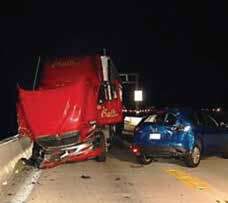
À 20h 24, une voiture particulière circulait en direction est sur l’US Route 50/301. La voiture a traversé la gare de péage pour emprunter la travée est du Chesapeake Bay Bridge, où la circulation était ralentie. La voiture a réduit sa vitesse à 4 mph lorsqu’elle a été percutée par l’arrière par une combinaison tracteur routier et semi-remorque frigorifique roulant à 47 mph. Le tracteur a heurté la voiture, la poussant contre la barrière en béton. Alors que les véhicules poursuivaient leur avancée, l’avant de la voiture a heurté une autre voiture occupée par un conducteur et son épouse. La voiture initiale a été projetée sur le haut de la barrière, a roulé le long de celle-ci puis est tombée d’environ 27 pieds dans la baie de Chesapeake, où elle s’est immobilisée entre deux piles de pont dans sept pieds d’eau. La conductrice a nagé jusqu’à une pile proche du pont, d’où elle a été secourue, transportée dans un hôpital local et soignée pour des blessures mineures. La deuxième voiture s’est arrêtée près du tracteur, au milieu des deux voies de circulation. Le conducteur du camion et les deux occupants de la deuxième voiture n’ont pas été blessés. Le NTSB a déterminé que la cause probable de l’accident était l’incapacité du conducteur du tracteur routier à ralentir pour s’adapter à la circulation en raison de son inattention à la voie devant lui, alors qu’il regardait dans son rétroviseur latéral.

5 août 2010, Gray Summit (Missouri)
La circulation était ralentie à l’approche d’une zone de travaux active en direction est sur l’Interstate 44. Un tracteur routier avait ralenti ou s’était arrêté derrière la file. À 10 h 11, une camionnette légère s’est insérée et a heurté l’arrière du tracteur. Cette collision a été la première d’une série de trois. Deux autobus scolaires abordaient la circulation ralentie et la collision en amont. Le premier autobus avait une capacité de 71 passagers et transportait 23 passagers; le second avait une capacité de 72 passagers et en transportait 31. Quelques secondes après que le bus de tête ait dépassé un autocar immobilisé sur la bande d’arrêt d’urgence, il a percuté l’arrière de la camionnette. Cette seconde collision a provoqué le renversement de la camionnette sur l’arrière du tracteur routier. L’avant du bus de tête est venu se poser sur la camionnette et le tracteur. Quelques instants plus tard, le bus suiveur a percuté le bus de tête. Le conducteur de la camionnette et un passager assis à l’arrière du bus de tête ont été tués. Au total, 35 passagers de bus, les deux conducteurs d’autobus et le conducteur du tracteur routier ont été blessés. Dix-huit personnes n’ont pas été blessées. Le NTSB a déterminé que la cause probable de la collision initiale était la distraction, probablement due à une conversation par texto du conducteur de la camionnette. La seconde collision résultait de l’inattention du conducteur d’autobus causée par une focalisation excessive sur un autocar stationné sur la bande d’arrêt d’urgence. La collision finale est survenue parce que le conducteur du bus suiveur n’a pas maintenu la distance minimale recommandée par rapport au bus de tête. La gravité de l’accident a été aggravée par l’absence de systèmes d’alerte de collision avant sur les deux autobus.
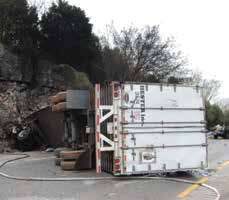
26 mars 2010, Munfordville (Kentucky)
Un ensemble tracteur–semi-remorque circulait vers le sud sur l’I-65 lorsqu’il a quitté la voie de gauche et est entré dans le terre-plein central en dépression de 60 pieds de large séparant les chaussées sud et nord. Le camion a traversé le terre-plein et a heurté puis franchi la barrière câblée de haute tension du terre-plein adjacente à l’accotement gauche de l’I-65 en direction nord. Il a ensuite franchi l’accotement et pénétré dans les voies en direction nord de l’I-65. Une fourgonnette de 15 places avec 12 occupants circulait vers le nord dans la voie de gauche. Alors que le camion traversait devant la fourgonnette, son tracteur a été percuté par celle-ci. À la suite de la collision et de l’incendie du camion qui s’en est suivi, le conducteur du camion, le conducteur de la fourgonnette et neuf passagers de la fourgonnette sont décédés. Deux enfants passagers dans la fourgonnette, qui étaient retenus par des dispositifs de retenue, ont subi des blessures mineures. La distraction du conducteur / l’utilisation du téléphone cellulaire a été déterminée comme l’une des causes de l’accident. En cartographiant la couverture des antennes cellulaires pour le téléphone du conducteur du camion, les enquêteurs ont déterminé que le conducteur avait utilisé son téléphone pour passer et recevoir des appels ainsi que pour envoyer et recevoir des textos à un total de 69 reprises pendant les 24 heures précédant l’accident.
More Reading