
 Plateforme d'eLearning
L’illusion des Stimulants: Pourquoi la Caféine est un Outil et les Amphétamines un Risque

Par Rodolfo Giacoman, Fatigue Management Specialist, Commercial Vehicle Safety Alliance
Publié à l’origine dans le Guardian, deuxième trimestre 2026, page 38
- La caféine peut être une alliée — lorsqu’elle est utilisée intelligemment — mais les stimulants comme les amphétamines constituent une catastrophe cachée au volant.
- Comprenez la neuro‑science : comment la caféine masque la pression de sommeil, pourquoi les amphétamines créent une fausse vigilance et comment les deux affectent le sommeil et la sécurité.
- Règles pratiques pour les conducteurs, éclairages sur les tests (cheveux vs urine), réalités de la certification médicale et où obtenir de l’aide pour rester qualifié.
Temps de lecture estimé : 6 minutes.
Les conducteurs affrontent une gamme de risques professionnels particulièrement étendue : troubles musculosquelettiques dus aux vibrations et à la position assise prolongée; hypertension et obésité liées aux heures sédentaires et à une mauvaise nutrition; apnée obstructive du sommeil et privation chronique de sommeil dues à des horaires irréguliers et aux quarts de nuit; et un risque potentiellement accru de cancer du poumon associé à une exposition professionnelle prolongée aux émissions diesel, en particulier dans les équipements plus anciens ou en milieu mal ventilé. À cela s’ajoutent le stress des longues périodes loin de la famille, l’exigence d’une vigilance mentale constante et des demandes de productivité intenses, qui créent un terreau propice à des comportements à risque tels que le tabagisme, la consommation excessive d’alcool, les liaisons occasionnelles et l’usage de substances psychoactives.
Les substances psychoactives n’affectent pas seulement le conducteur qui les consomme. Elles retardent les temps de réaction, troublent le jugement et altèrent des fonctions exécutives — prise de décision, reconnaissance des dangers et contrôle des impulsions — nécessaires pour maintenir un véhicule lourd hors de la circulation opposée. Comme souligné dans la une du « Guardian » du troisième trimestre 2025, la consommation de drogues et la fatigue sont systématiquement identifiées parmi les facteurs contributifs fréquemment cités, aux côtés de la vitesse excessive, des conditions routières et de la distraction du conducteur dans les accidents mortels impliquant des camions.
Quand j’enseigne des cours de gestion de la fatigue destinés aux responsables de la sécurité, certains connaissent le fonctionnement de la caféine et l’utilisent judicieusement; très peu connaissent les amphétamines, qui présentent des risques de sécurité significatifs en contexte de conduite et constituent généralement un motif de non‑certification sauf évaluation médicale rigoureuse selon les normes de certification de la FMCSA. Traiterons les deux ici.
Utiliser la Caféine Judicieusement
La caféine est la substance psychoactive la plus consommée au monde et, pour les conducteurs de véhicules commerciaux (CMV), c’est l’unique outil légal qui aide véritablement à gérer la vigilance lorsqu’elle est utilisée correctement. Comprendre son mécanisme fait la différence entre l’utiliser comme atout et, sans le vouloir, aggraver la fatigue.
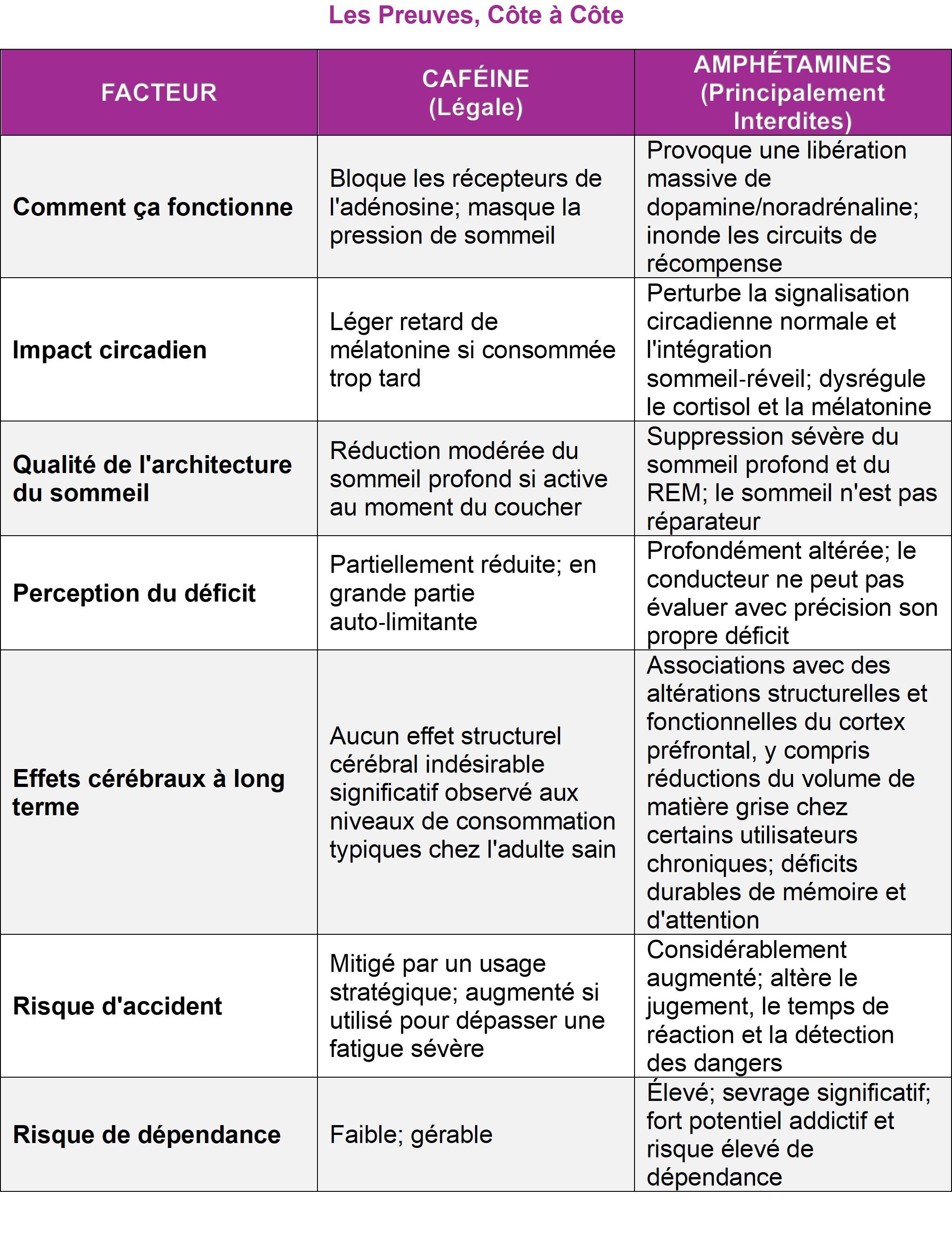
Ce que fait la caféine Chaque heure d’éveil entraîne l’accumulation dans le cerveau d’une molécule nommée adénosine, sous‑produit de l’activité cérébrale qui augmente la pression homéostatique du sommeil au fil de la journée. Après environ 16 heures éveillé, cette pression devient difficile à contrer. La caféine agit en bloquant les récepteurs de l’adénosine, empêchant le cerveau de recevoir le signal d’endormissement. Elle ne génère pas d’énergie ni de vigilance authentique; elle masque la fatigue déjà présente. La dette de sommeil, matérialisée par l’adénosine, continue de s’accumuler en coulisse.
C’est pourquoi la caféine a un plafond d’efficacité. Elle peut nous acheter du temps et améliorer la concentration à court terme, mais elle ne remplace pas le sommeil réel et, si elle est utilisée sans précaution, elle dégradera activement la qualité du sommeil que nous obtenons.
Règles Caféinées pour le Conducteur Avisé
- Arrêter 6–8 heures avant le sommeil. La caféine a une demi‑vie d’environ 5–7 heures chez la plupart des adultes (avec une variabilité individuelle significative). Un café à 15 h peut encore conserver la moitié de sa caféine active à 21 h, précisément au moment où notre cerveau a besoin que l’adénosine augmente la pression pour un sommeil profond et réparateur. Une consommation tardive supprime le sommeil profond même si l’endormissement se produit normalement.
- Essayer le « nap‑uccino ». Boire une tasse de café puis faire immédiatement une sieste de 20 minutes. La caféine met 20–30 minutes à agir; on peut se réveiller juste au moment où elle commence à faire effet, plus reposé et alerte. Limiter la sieste à 20 minutes ou moins pour éviter de se réveiller groggy après du sommeil profond.
- Connaître la limite absolue. Après plus de 16 heures éveillé, la caféine réduit notre capacité à percevoir l’ampleur de notre altération. À ce stade, aucune quantité de café ne remplace l’arrêt et le sommeil.
Utilisée dans ces garde‑fous, la caféine est une alliée réelle. Utilisée en dehors d’eux, notamment pour forcer au‑delà d’une fatigue sévère, elle devient un outil d’auto‑tromperie sur le degré de danger que nous représentons.
Amphétamines: L’oxyde Nitreux du Cerveau
Les amphétamines sont une substance contrôlée de l’Annexe II. La loi fédérale encadre strictement leur usage et elles constituent, en règle générale, un motif de non‑certification pour les conducteurs de CMV sauf si une exception médicale très limitée est satisfaite. Bien qu’un Medical Review Officer (MRO) puisse valider un dépistage comme négatif si une prescription légitime est présente, l’examinateur médical peut néanmoins refuser la certification. L’examinateur doit évaluer si la condition sous‑jacente (p. ex. le TDAH) ou les effets secondaires du médicament présentent un risque pour la sécurité.
Les amphétamines donnent la sensation d’être alerte tout en démantelant les systèmes cérébraux qui génèrent la vigilance réelle. C’est la neuroscience de l’auto‑tromperie à 70 miles par heure.
Comment elles Fonctionnent et Pourquoi c’est Problématique
Là où la caféine bloque discrètement un récepteur, les amphétamines, chez les personnes qui les consomment illicitement ou sans besoin médical, déclenchent une réaction chimique violente. Elles augmentent les concentrations synaptiques de dopamine et de noradrénaline en favorisant leur libération et en inhibant leur recapture, entraînant une vigilance accrue et une perception d’attention intensifiée. Pour un conducteur éveillé depuis 20 heures, cela ressemble à un salut. Ce n’en est pas un. C’est un court‑circuit.
Le système circadien cérébral, l’horloge interne qui régule le cortisol le matin et la mélatonine la nuit, fonctionne grâce à une signalisation neurochimique rythmique précise. Les amphétamines inondent ce système à toute heure, perturbant la signalisation circadienne normale et masquant la capacité du cerveau à interpréter correctement les indices temporels du sommeil. Le conducteur se sent parfaitement éveillé à 3 h du matin, non parce que son organisme est prêt à être éveillé, mais parce que l’horloge biologique a été détournée chimiquement.
Pensez‑y mécaniquement: la caféine, c’est un appui plus fort sur l’accélérateur; le moteur travaille davantage, mais comme prévu. Les amphétamines, c’est de l’oxyde nitreux injecté dans la chambre de combustion. La poussée est réelle. Mais l’oxyde nitreux brûle plus chaud que ce que le moteur peut soutenir, consommant la capacité future en échange de la performance présente.
Effets Sur le Sommeil
Les amphétamines suppriment sévèrement le sommeil profond à ondes lentes et le sommeil paradoxal (REM), deux phases critiques pendant lesquelles le cerveau et le corps se restaurent. Un conducteur qui consomme des amphétamines puis dort présente souvent une qualité de sommeil réparateur nettement réduite, en particulier dans les stades de sommeil profond et de REM. Sur plusieurs jours et semaines, cela engendre un déficit cumulatif qui se manifeste par paranoïa, prises de décision impulsives, volatilité émotionnelle et attention défaillante — précisément les fonctions qui permettent à un conducteur et à son entourage de rester en sécurité.
L’usage chronique ou à fortes doses a été associé à des modifications structurelles et fonctionnelles du cortex préfrontal, centre cérébral du jugement et du contrôle des impulsions.
La caractéristique la plus dangereuse des amphétamines est la confiance qu’elles fabriquent. Le conducteur se sent véritablement alerte. Il ne peut pas estimer correctement son degré d’altération. Cet écart — entre la performance ressentie et la performance réelle — est ce qui augmente significativement le risque d’accident en conduite sous stimulants.
Prescription vs Rue: Ce n’est pas le Même Usage
Une question courante parmi conducteurs et responsables de la sécurité familiers avec les médicaments contre le TDAH est de savoir si les amphétamines prescrites (p. ex. Adderall ou Vyvanse) diffèrent des drogues de rue détectées dans les tests. Elles appartiennent à la même classe pharmacologique mais s’inscrivent dans un contexte totalement différent et font l’objet d’une évaluation médicale stricte selon la réglementation FMCSA.
Les deux contiennent des composés amphétaminiques (dextroamphétamine ou sels mixtes d’amphétamine) qui agissent via les mêmes voies dopaminergiques et noradrénergiques. Les deux peuvent supprimer le sommeil profond et le REM, perturber le rythme circadien et sont détectables par les tests de dépistage du Department of Transportation (DOT) des États‑Unis.
Les stimulants prescrits pour le TDAH sont administrés à des doses contrôlées, calibrées cliniquement et sous surveillance médicale. Chez les personnes atteintes de TDAH, qui peuvent présenter des différences dans la signalisation de la dopamine et de la noradrénaline liées à la régulation de l’attention, ces médicaments peuvent normaliser la fonction cérébrale plutôt que l’« inonder », améliorant souvent l’attention soutenue sans la poussée euphorique associée à l’usage illicite. L’effet neurochimique est comparativement plus modeste et ciblé.
Les amphétamines de rue et la méthamphétamine sont consommées à des doses beaucoup plus élevées et non contrôlées, sans supervision médicale. La méthamphétamine est plus lipophile, ce qui lui permet d’entrer dans le cerveau plus rapidement, d’y rester active plus longtemps et de produire des effets du système nerveux central d’une durée supérieure, provoquant un pic de dopamine bien plus élevé que les formulations prescrites. Cela entraîne une perturbation du sommeil plus sévère, une dépendance plus rapide et des dommages cognitifs plus importants au fil du temps.
Aux termes du Titre 49 du Code of Federal Regulations § 391.41(b)(12), un conducteur ne peut utiliser une substance contrôlée de l’Annexe II que si elle est prescrite par un praticien licencié, familiarisé avec les fonctions du conducteur, et ayant déclaré que la substance n’affectera pas négativement l’exploitation sécuritaire. L’autorité finale de certification appartient à l’examinateur médical de la FMCSA.
Même lorsque la prescription existe et que le MRO l’a vérifiée, l’usage de stimulants n’oblige pas l’examinateur médical à délivrer la certification. Les décisions de certification varient selon le jugement de l’examinateur, le profil des effets secondaires, la stabilité posologique et la performance fonctionnelle documentée.
Que Disent les Tests Capillaires aux Employeurs
Schneider National, l’un des plus grands transporteurs d’Amérique du Nord, a commencé les tests capillaires en 2009. Les tests urinaires DOT standard détectent la plupart des drogues pendant seulement deux à cinq jours et sont relativement limités par de courtes fenêtres de détection face à de brèves périodes d’abstinence ou à la dilution des échantillons.
Parce que les drogues sont incorporées dans la tige capillaire au fur et à mesure de sa croissance, un échantillon standard de 1,5 pouce fournit une fenêtre de détection étendue (environ 90 jours), bien qu’il ne soit actuellement pas approuvé pour les tests de conformité DOT aux États‑Unis et présente des limites connues liées à l’exposition environnementale et à la variabilité temporelle ou aux substitutions.
Depuis l’implémentation des tests capillaires, Schneider National rapporte que les amphétamines et la cocaïne figurent parmi les substances les plus fréquemment détectées dans les programmes de dépistage capillaire aléatoire, des substances que les tests urinaires seuls auraient largement manquées. Pour les responsables sécurité, cette lacune représente des conducteurs qui auraient été déclarés sans drogue mais qui, en réalité, ne l’étaient pas. (La cocaïne, bien que pharmacologiquement distincte, perturbe également la signalisation dopaminergique et compromet le jugement et le contrôle des impulsions, générant des risques de sécurité similaires en contexte de conduite.)
Si les transporteurs peuvent utiliser les tests capillaires pour filtrer des candidats à haut risque, ces résultats ne sont pas actuellement déclarables au FMCSA Drug and Alcohol Clearinghouse. Seuls les tests d’urine ou de salive requis par le DOT ont le poids d’une interdiction fédérale formelle. La loi fédérale interdit d’exploiter un CMV sous l’influence de toute substance contrôlée. Un test positif entraîne le retrait immédiat des fonctions sensibles à la sécurité, l’orientation obligatoire vers un Substance Abuse Professional (SAP) qualifié par le DOT et une inscription déclarable dans le FMCSA Drug and Alcohol Clearinghouse.
L’altération est réelle que l’on soit testé ou non. Les effets pharmacologiques se produisent indépendamment de la réalisation d’un test ou de la détection de la substance.
Comment Obtenir de l’aide et Rester Certifié
Le dossier en neurosciences contre l’usage d’amphétamines est clair. Mais savoir pourquoi quelque chose est nocif et pouvoir y renoncer sont deux choses distinctes. Le trouble lié à l’usage d’amphétamines est une condition médicale reconnue, portée par de véritables changements neurochimiques que la seule volonté peine généralement à surmonter. Si des conducteurs se reconnaissent dans cet article, l’essentiel à savoir est qu’il s’agit d’un problème médical avec des solutions médicales.
La stigmatisation de l’addiction dans l’industrie du camionnage incite les conducteurs à continuer de consommer par crainte que demander de l’aide leur coûte leur CDL et leur gagne‑pain. Cette peur est réelle. Elle est toutefois généralement plus grande que la réalité et nettement moins dangereuse que de continuer à conduire sous l’effet de substances.
Où Obtenir de l’aide
Ligne nationale SAMHSA : 1‑800‑662‑4357
Service gratuit, confidentiel, 24/7, aucune assurance requise. Orientation vers des traitements pour les troubles liés à l’usage de substances.
Programme DOT Substance Abuse Professional (SAP)
Les conducteurs qui s’auto‑référent ou qui obtiennent un test positif sont évalués par un SAP qualifié par le DOT qui recommande un traitement. La réussite du processus de retour au service peut rétablir les privilèges de conduite sensibles à la sécurité. Le rétablissement et le retour au travail sont possibles.
Programmes d’aide aux employés (EAP)
De nombreux transporteurs offrent des EAP confidentiels avec counseling gratuit et orientation, séparés du processus réglementaire de dépistage. L’auto‑référence volontaire avant un test positif entraîne des conséquences sensiblement différentes et meilleures que d’être détecté. L’auto‑référence doit intervenir avant la notification d’un test obligatoire pour bénéficier des protections habituelles de la politique EAP du transporteur.
FMCSA Drug and Alcohol Clearinghouse
Comprenez vos droits et le processus de retour au service sur clearinghouse.fmcsa.dot.gov avant que la peur de l’inconnu ne vous empêche d’agir.
Notre cerveau est notre équipement le plus critique, il nécessite le bon carburant et une récupération adéquate pour fonctionner. Utilisez la caféine de façon stratégique, respectez notre besoin de sommeil et, si vous constatez que vous vous appuyez sur un raccourci chimique, empruntez la voie professionnelle : demandez de l’aide, rétablissez‑vous et conservez votre qualification. L’éducation proactive et l’auto‑déclaration volontaire sont des composantes clés d’un programme de sécurité conforme et sont encouragées dans toute l’industrie du transport. Envoyez vos commentaires et questions à rodolfo.giacoman@cvsa.org.
More Reading